Accepting a new postdoc or research position in Korea is an exciting career move. But once your research contract is signed, another question quickly becomes important: How do you move the life you built in the United States to Korea?
Your passport, laptop, and a few essentials can travel with you on the plane. Your books, clothing, research-related belongings, and years of personal items are another matter.
For a postdoc or researcher moving from the USA to Korea, international relocation is not simply about booking a flight. You also need a plan for packing, moving your boxes out of your U.S. residence, temporary storage if your dates do not align, international transportation, and customs clearance in Korea.
- A new research position in Korea may require a separate moving plan for belongings left in the United States.
- A Moving Kit can simplify packing by providing essential packing and labeling supplies.
- FedEx Drop-off, Standard Pickup, and Premium Pickup provide different ways to send packed boxes.
- Storage can bridge the gap between your U.S. move-out date and your Korea move-in date.
- Customs requirements should be checked according to your individual immigration, residency, and moving circumstances.
Moving to Korea for a New Research Position
Imagine that you are currently working at a university or research institution in the United States. You receive an offer from a university, laboratory, or research institution in Korea and sign your new research contract.
Your destination is now clear: Korea.
But your research contract does not automatically solve your moving logistics.
You may have a bookshelf filled with academic books, clothing from several seasons, kitchen items, personal belongings, and boxes accumulated during years of living in the United States.
That creates a practical distinction:
Your career has a destination. Your belongings need a transportation plan.
Why Two Suitcases May Not Be Enough
For a short trip, airline baggage may be sufficient. Relocating your life to another country is different.
A researcher who has lived in the United States for several years may have far more belongings than can reasonably travel as checked baggage.
Instead of asking, “How much can I fit into my suitcase?” it can be more useful to separate your belongings into categories.
Travel with you: passport, essential documents, laptop, medications, valuables, and items you will need immediately after arrival.
Move separately: books, clothing, household belongings, and other appropriate personal items that do not need to travel on the same flight.
This allows your flight and your moving boxes to follow different schedules when necessary.
Step 1: Start Packing Before Your Research End Date
One common mistake is waiting until the final days of a research appointment or apartment lease to start packing.
Researchers may already be busy with experiments, final reports, manuscript submissions, laboratory handovers, administrative paperwork, and preparations for their new position in Korea.
Preparing packing materials in advance can make the transition much easier.
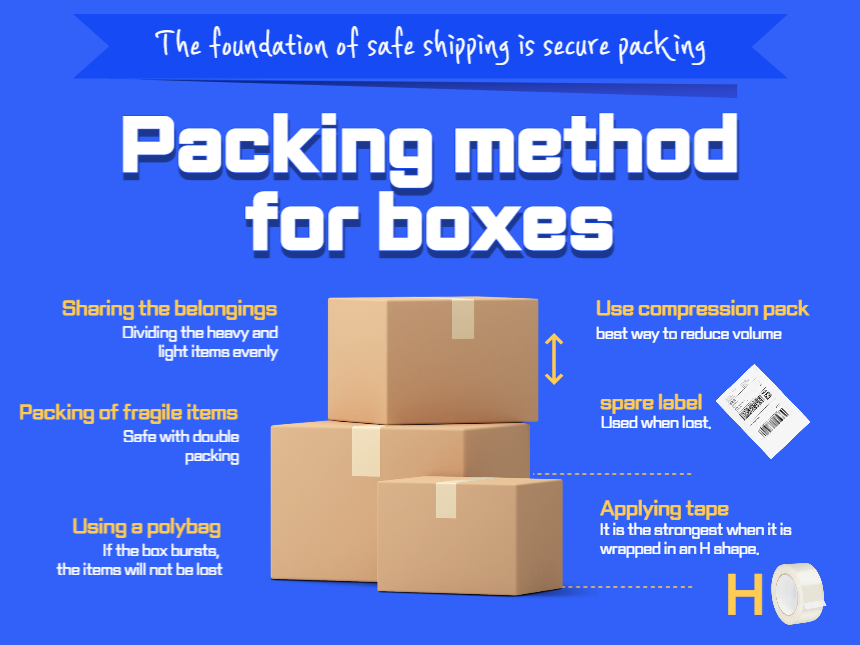
UC Moving's Moving Kit is designed to provide essential materials for preparing moving boxes at home, including moving boxes, packing tape, pre-printed shipping labels, label pouches, and identification labels.
Instead of separately searching for boxes, tape, and a way to print shipping labels, you can prepare the basic packing materials before your move-out date.
Once packed, each box should be securely sealed and labeled before it is handed over for transportation.

Step 2: Choose the Right Way to Send Your Boxes
Not every researcher has the same moving situation. Some people have only a few manageable boxes, while others may have many heavy boxes and no convenient way to carry them downstairs.
UC Moving provides several shipment options depending on the situation.
FedEx Drop-off
If you can transport your packed boxes yourself, FedEx Drop-off can be a flexible option.
You take the prepared boxes to an appropriate FedEx drop-off location during its available business hours. Locations that operate on weekends may also provide additional scheduling flexibility.
This can be useful when you prefer to send your boxes according to your own schedule rather than wait for a pickup driver.
Standard Pickup
Standard Pickup eliminates the need to transport your packed boxes to a FedEx drop-off location yourself.
You prepare the boxes at the designated pickup location and a driver collects them. Because drivers generally make pickups sequentially along their route, however, an exact pickup time may be difficult to set.
You should therefore consider whether the designated pickup location is suitable for leaving packed boxes while waiting for collection, particularly when weather exposure or security is a concern.
Premium Pickup
If you have multiple heavy boxes, an apartment with difficult access, or a strict move-out schedule, Premium Pickup can reduce the physical work involved.
With Premium Pickup, you can set a pickup time and the pickup team comes inside your residence to collect your already packed boxes.
This means you do not have to repeatedly carry heavy boxes through long hallways, elevators, stairs, or down to an outside pickup area.
It can also reduce the need to leave boxes outside for an extended period, where rain, snow, moisture, theft, or unauthorized movement could become concerns.
.png)
Step 3: What If Your U.S. and Korea Dates Don't Match?
This is an important issue for postdocs and researchers.
Your new research contract in Korea may already be confirmed, but that does not mean every date will line up perfectly.
For example:
July 31: U.S. apartment lease ends
August 15: New research position begins in Korea
September 1: Housing in Korea becomes available
Where should your belongings go between July 31 and September 1?
This is where a moving service connected with storage can be useful.
Instead of forcing your boxes to arrive in Korea before you have a place to receive them, your belongings can be stored during the scheduling gap and moved onward when you are ready.
The basic concept is simple:
U.S. Move-Out → Storage → Korea Delivery
Your flight date and the delivery date of your moving boxes do not necessarily have to be identical.
Why This Can Be Different From Using a Local Self-Storage Unit
A local self-storage facility can be useful when you simply need space to keep belongings. But researchers planning an international relocation should also think about what happens after storage.
If you place everything in a local storage unit yourself, you may later need to return to the facility, retrieve the belongings, arrange transportation, and organize international moving separately.
That can become particularly inconvenient if you have already left the United States.
For someone whose final destination is already Korea, it may therefore make sense to consider storage as one stage of the overall moving process rather than as an isolated solution.
Step 4: Prepare for Customs When Moving to Korea
International moving also involves customs procedures.
Foreign postdocs and researchers should not assume that customs treatment is identical for every person moving to Korea. Requirements can depend on factors such as nationality, immigration or residency status, expected length of stay, and the types of belongings being imported.
The Korea Customs Service provides official English-language information for foreigners bringing moving household effects into Korea.
Before shipping your belongings internationally, check the current Korea Customs Service requirements that apply to your specific circumstances and prepare the necessary documentation accordingly.
This is particularly important for researchers entering Korea under a new employment or research arrangement because your individual entry and residency circumstances can affect which documentation is relevant.
Step 5: Keep Relocation Expense Documentation
Some universities and research institutions provide relocation support or require documentation for moving expenses.
If you use UC Moving and need an invoice, you do not need to separately request a manually prepared invoice each time.
After payment has been completed, log in to the UC Moving website and go to:
My Page → Completed Payment → Print Invoice
You can then use the printed invoice as supporting documentation when your university or research institution requests evidence of relocation expenses, subject to that institution's own reimbursement requirements.
A Simple Moving Plan for Researchers
For many researchers, the easiest way to understand the entire process is to separate it into a few stages:
New Research Contract in Korea
↓
Prepare Your U.S. Move
↓
Moving Kit & Packing
↓
FedEx Drop-off / Standard Pickup / Premium Pickup
↓
Storage, If Needed
↓
International Transportation
↓
Korea Customs
↓
Delivery in Korea
The important point is that you do not necessarily need to force every step to happen on the same day.
Your U.S. apartment can have one deadline. Your flight can have another date. Your research position can begin on another date, and your housing in Korea may become available later.
A moving plan should be built around those realities.
From Your U.S. Lab to Your New Research Life in Korea
Moving to Korea for a new postdoc or research position is more than a change of workplace.
You are closing one chapter of your life in the United States while beginning another in Korea.
Your books, personal belongings, and the things you accumulated during your years in the U.S. are part of that transition too.
Plan your packing early, choose a pickup method that fits your situation, use storage when there is a scheduling gap, and verify the customs requirements that apply to you before international shipment.
Most importantly, give yourself enough time to focus on what brought you to Korea in the first place: your next research opportunity.
We wish you all the best with your research and your new life in Korea.
Plan your move from the U.S. to Korea with UC Moving.
Move smarter from the start.
Postdoc Moving to Korea, Researcher Moving to Korea, Moving from USA to Korea, International Moving to Korea, UC Moving